If Instagram is working for you, keep it — but a social page is rented attention, and a website is the only part of your online presence you actually own. The practical question isn't "website or Instagram", it's whether you're losing buyers at the moment they try to check you out.
We get this question nearly every week, usually from businesses doing real revenue through DMs. The honest answer is that social-only works for longer than agencies like to admit, and then it fails in very specific, predictable ways. Here's how to tell which side of that line you're on.
What Instagram and WhatsApp genuinely do well
Start with the fair version, because a lot of advice on this topic is just agencies selling websites.
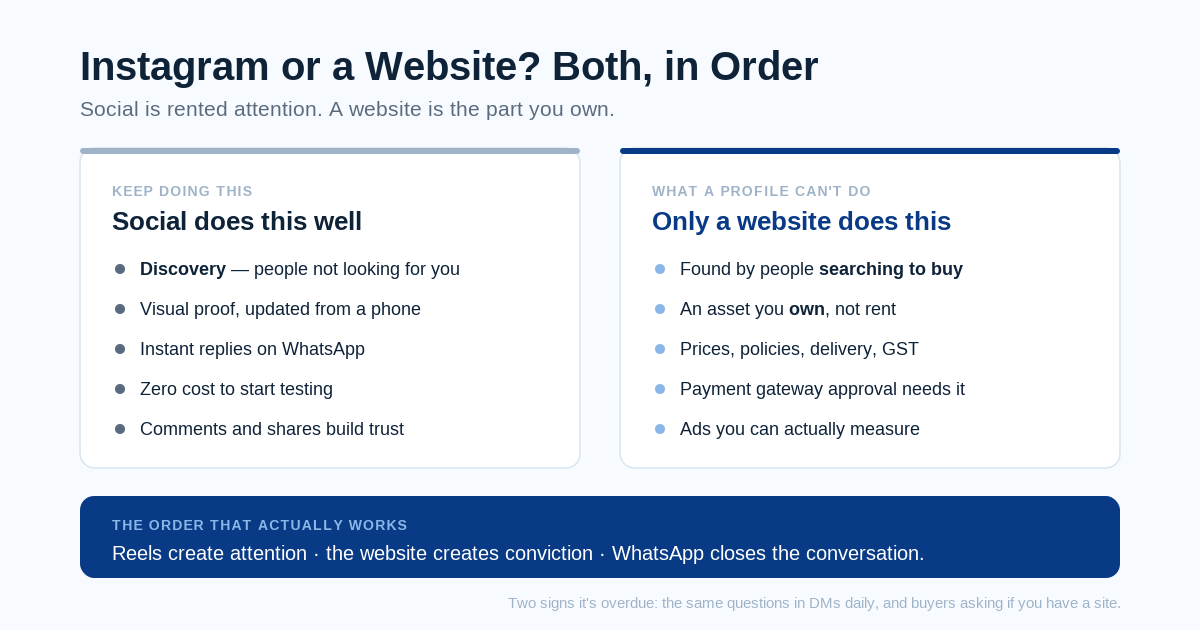
Social platforms are excellent at discovery. They put your work in front of people who weren't looking for you, which no website does on its own. For a bakery, a boutique, a photographer, or an interior designer, that visual feed is the portfolio, and it updates in minutes from a phone.
They're also excellent at conversation. An Indian customer who can ask "is this available in blue" on WhatsApp and get a reply in two minutes is a far warmer lead than one filling in a contact form. That immediacy is a real advantage, and a website doesn't replace it.
And the cost of entry is zero. For a business still testing whether a product sells at all, spending ₹40,000 on a website before you know anyone wants the thing is the wrong order of operations.
So: if you're early, visual, local, and handling a manageable number of orders a day, social-only is a legitimate strategy. Don't let anyone shame you out of it.
The four things a social page structurally cannot do
What changes the calculation isn't fashion, it's these four gaps. None of them is fixable with better posting.
1. You cannot be found by someone searching. When a person types "wedding photographer in Jaipur" or "modular kitchen near me" into Google, that person has already decided to buy — they're only choosing who from. Instagram profiles rarely surface for those searches. Your website can, and that's the difference between hoping for attention and receiving intent. If you serve a specific city, this is the biggest gap of the four, and closing it is exactly what local SEO is for.
2. You don't own the audience. A hacked account, a mistaken policy strike, or a change in how the feed is ranked can remove your entire customer channel overnight, with no appeal that moves on your timeline. We've watched it happen to businesses with tens of thousands of followers. A domain and a site you control cannot be taken away by someone else's product decision.
3. There's nowhere to put the boring, decisive information. Prices. Service areas. Turnaround time. Shipping. Returns. Warranty. GST details. Bio-link tools help, but they're a workaround. The buyer who needs this before paying is usually your most serious buyer, and in DMs you answer those questions one at a time, forever.
4. You can't take online payments properly. This one surprises people: Indian payment gateways require a live website with visible Terms, Privacy, Refund, and Shipping policy pages before they'll approve your account. Social-only means UPI QR codes and manual matching of payments to orders — workable at ten orders a day, a genuine problem at fifty, as we covered in the payment gateway comparison.
Social media is where people notice you. A website is where they decide. You need both, and you only own one of them.
Four signs you've outgrown social-only
Stop debating the principle and check the symptoms. Any two of these and a website is overdue:
- You answer the same questions in DMs every day. Price, timeline, do-you-deliver-to-X. Every repeat is unpaid labour a page could have handled while you slept.
- Buyers ask whether you have a website before they pay. For anything above roughly ₹5,000, Indian buyers look for a site as a legitimacy check. No site reads as "might vanish tomorrow" — unfairly, but reliably.
- You want to run ads. Sending paid traffic to a profile wastes most of it. Nothing on a feed is built to convert a stranger, and you can't see what people did after the click.
- You're selling to businesses, not just consumers. B2B buyers, exporters, and corporate procurement will not raise a purchase order for a business with no website, and a domain-based email address is often a hard requirement.
What to build instead of "a website"
The mistake that wastes money here isn't skipping a website. It's building the wrong one — a five-page brochure site, slow, written in vague corporate language, that converts worse than the Instagram page it replaced.
For a business coming from social, what works is small and sharp:
- One page that answers the buying questions. What you do, who it's for, proof you've done it, a price or price range, service area, and one obvious action. That's genuinely it.
- Real proof. Photos of actual work, client names where you're allowed to use them, real reviews. Your Instagram grid is already this — reuse it.
- WhatsApp as the primary call to action. Don't fight your customers' habits. A click-to-WhatsApp button converts better than a contact form in most Indian markets. Keep the form as the secondary option.
- Speed. A site that takes six seconds on a 4G connection loses most of the people who clicked, and this is the most common reason a new site gets traffic but no leads.
- A Google Business Profile wired to it. For a local business, this pairing does more than any amount of posting.
What you can safely skip at launch: a blog you won't maintain, a team page with three people on it, a mission statement, stock photos of handshakes, and a carousel of slogans.
Keep the social, add the foundation
The right mental model isn't replacement, it's a sequence.
Instagram and Reels create attention. The website turns attention into conviction — it holds the prices, the proof, the policies, and the answers. WhatsApp closes the conversation. Each does a job the other two can't.
And if you're wondering whether to leap further and build an app instead, the answer is almost always no — we've laid out why in website vs mobile app.
What to do this week
If you're social-only and any two symptoms above apply, the next step is deliberately unambitious:
- Buy your domain today, even if the site comes later. Names get taken, and a domain-based email address is worth having on its own.
- Write down the five questions you answer most in DMs. That list is your website's content brief — you've already done the research.
- Build one page, properly. Fast, honest, specific, with a WhatsApp button. Launch it in a week, not a quarter.
- Then add, based on evidence. Catalogue, bookings, payments, blog — each one only when a real customer asks for it.
A website isn't a status symbol, and it isn't a replacement for the work you're already doing on social. It's the part of your online presence that keeps working when the algorithm changes its mind. If you want a second opinion on what your business actually needs right now, that's the kind of thing we're happy to be blunt about on a website development enquiry — including telling you to wait.
Want help putting this into practice? See our Website Development service or get a free audit.