For the large majority of businesses, the website comes first and the app comes later — or never. A website is cheaper, findable on Google, and usable with zero installation friction; an app only earns its cost when you have proven, repeat users who want to come back.
"Should we get an app made?" is one of the most common questions we're asked, and it's usually asked too early. The honest answer depends on one thing — whether your customers use you once, or use you weekly — and this post lays out how to tell the difference before you spend the money.
The core difference: reach versus retention
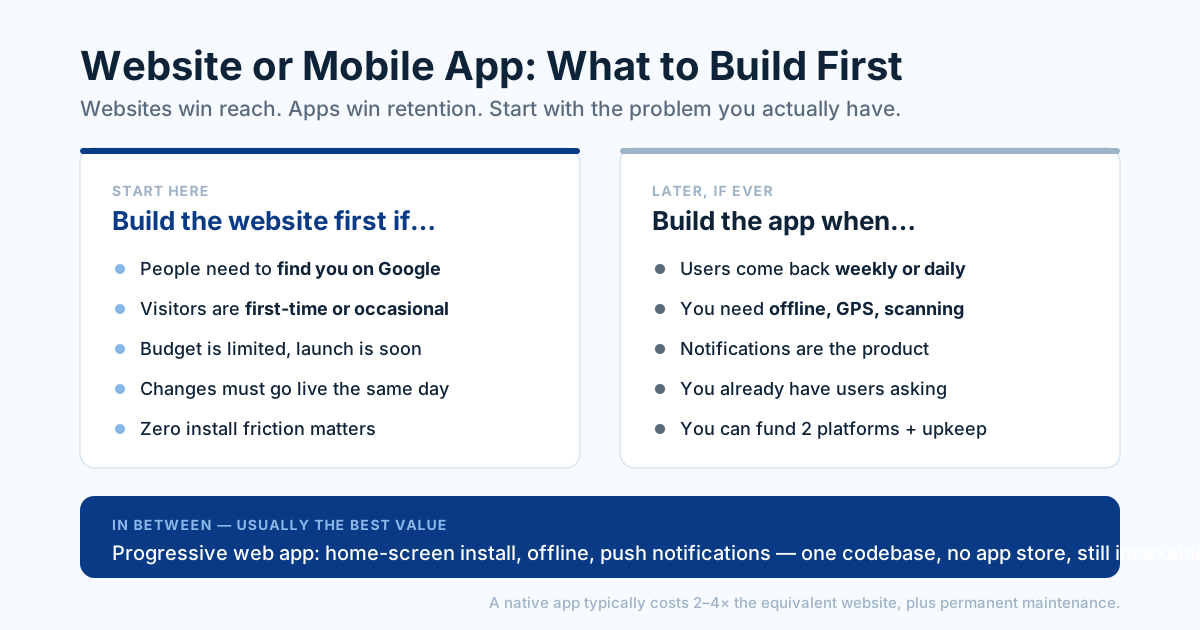
Websites win reach. Apps win retention. Nearly every sensible decision follows from that one sentence.
A website is one link away from a Google result, a WhatsApp message, an Instagram bio, or an ad. There is no install step, no storage cost on someone's phone, no review queue. A first-time visitor who has never heard of you can be on your pricing page two seconds after tapping a link.
An app is the opposite. Getting someone to install it is genuinely hard — that's a search, a download, an account, and permission prompts before they see anything useful. But once installed, it sits on the home screen, remembers who they are, and can send a notification. For a customer who returns twice a week, that's a real advantage.
So the question isn't "which is better." It's which problem do you have? If your problem is "not enough people find us," an app cannot fix it. If your problem is "people use us constantly and the browser is getting in their way," an app might.
What each one actually costs
Cost is where the decision usually becomes obvious. A comparable app is typically 2–4x the price of the website, and the gap widens over time rather than closing.
Three reasons the multiplier exists:
- Two platforms, not one. Android and iOS, each with its own testing, quirks, and release process. Cross-platform frameworks help, but "one codebase" never means "half the work" once you hit device-specific behaviour.
- App store overhead. Developer accounts, review submissions, rejections that cost a week, store listings, screenshots, privacy declarations. This is real project time that produces nothing a user can see.
- Updates are forever. A website update is live the moment it's deployed. An app update has to pass review, then be installed by each user — which means supporting old versions of your app for months. Every year, OS releases also force maintenance work you didn't plan for, whether or not you changed anything.
Compare that to the ongoing cost of maintaining a website, which is modest and predictable. An app is not a one-time purchase; it's a subscription you pay in developer time.
Ask what an app would do that a good mobile website couldn't. If the honest answer is "look more serious," you don't need an app — you need a better website.
The middle option most people don't know about
Before choosing between the two, know that there's a third answer: a progressive web app (PWA). It's a website, built with modern web technology, that can be installed to the home screen, opened without a browser bar, work offline, and send push notifications on both Android and iOS.
A PWA gets you:
- A home-screen icon and a full-screen, app-like experience
- Offline support and fast repeat loads via caching
- Push notifications
- One codebase, no app stores, instant updates
- Everything still indexable by Google, because underneath it's a website
What it can't do is deep hardware access — advanced camera control, Bluetooth peripherals, background location tracking, heavy on-device processing. If your product doesn't need those, a PWA covers most of what people actually meant when they asked for an app. It's usually the highest-return option for service businesses, booking systems, dashboards, and internal tools.
When an app is genuinely the right call
None of this means apps are wrong. They're right when at least two of these are true:
- Usage is frequent and habitual. Daily, or several times a week. Delivery, logistics tracking, fitness, finance, learning streaks, field-staff tools.
- You need device capabilities the web can't reach. Continuous GPS, high-speed barcode scanning, Bluetooth hardware, offline-first data capture in poor-network areas.
- Notifications are the product, not decoration. Order status, price alerts, shift schedules — reminders people would genuinely miss otherwise.
- You already have the audience. An existing base of users asking for an app is the strongest signal there is, and the cheapest launch an app can have.
- The app is a retention tool for existing customers, not a discovery channel for new ones. Nobody discovers you in the app store.
If you're building a marketplace, a subscription service, or a field-operations tool with repeat daily use, an app is a reasonable investment. If you're a clinic, a consultancy, a manufacturer, a restaurant, or a store selling mostly to first-time buyers, the money is better spent making the website faster, clearer, and easier to find.
The sequence that works
For almost everyone, the practical path runs in the same order:
1. Build the website properly. Fast, mobile-first, findable. This is your storefront, your credibility, and your discovery channel at once. Get it right before adding anything — and if speed is the weak point, fix that before considering a second platform.
2. Watch what people actually do. Analytics will tell you within a few months whether you have repeat users or one-time visitors. This is the data that answers the app question, and it costs nothing to collect.
3. Add app-like features to the web when a pattern shows. Home-screen install, offline access, notifications — added to the site you already have, for a fraction of an app build.
4. Build the native app only when the web version is straining. When users are genuinely limited by the browser and you can name the specific capability you're missing, the investment makes sense. By then you'll also know exactly what to build, because your users have been telling you for months.
Plenty of businesses stop at step 3 permanently, and are right to. The ones who skip straight to step 4 usually end up with an app with forty installs and a website that still doesn't rank — an expensive way to learn the sequence.
A quick self-test
Answer these honestly:
- Would a customer use this more than once a month? (No → website.)
- Can they achieve their goal in a browser today? (Yes → website, made better.)
- Do you have an existing audience asking for an app? (No → website.)
- Do you need hardware or offline capabilities the web genuinely can't reach? (No → PWA at most.)
- Can you fund a second build plus ongoing maintenance for both? (No → website.)
Five noes means the answer is settled, and the good news is that it's the cheaper answer.
If you're weighing this for a specific product — especially something with logins, dashboards, or real business logic behind it — the first conversation should be about the workflow, not the platform. That's where a custom web application scoping session tends to save more money than any technology choice, because it settles what you're building before deciding where it runs.
Want help putting this into practice? See our Custom Panels & Dashboards service or get a free audit.