Website maintenance in India typically runs ₹3,000–8,000 a month for a business site, ₹15,000–40,000 for an e-commerce store, and a proper retainer for anything with real users behind a login. As a rule of thumb, budget 10–20% of the original build cost per year — and insist on knowing exactly what those hours buy.
Maintenance is the line item everyone negotiates hardest and understands least. It's quoted as a single monthly number covering wildly different amounts of work, so "₹5,000 a month" from two agencies can mean a genuine service or an email address that sometimes replies. Here's how to tell them apart.
What maintenance actually is
It helps to split the word into four separate jobs, because most disputes come from a client and a developer using "maintenance" to mean different ones.
1. Keep it alive. Hosting, domain and SSL renewal, DNS, uptime monitoring, backups that have actually been restore-tested. Unglamorous, and the category that causes the most damage when skipped — an expired domain can take a business offline for days, and a backup nobody has ever restored is a guess, not a backup.
2. Keep it safe. Security patches, CMS and plugin updates, dependency upgrades, spam and bot filtering, access reviews when staff leave. Most small business sites aren't hacked deliberately; they're found by an automated scanner looking for a known vulnerability in an outdated plugin.
3. Keep it current. Content edits, new pages, price and photo changes, adding a team member, publishing a blog post. This is the part clients think of as maintenance, and it's usually the smallest slice of the actual risk.
4. Keep it improving. Speed work, fixing what analytics shows is broken, SEO housekeeping, conversion tweaks. Optional — but this is the only bucket that makes you money rather than preventing losses.
A plan that only covers bucket 3 is a content service. A plan covering 1 and 2 is real maintenance. Know which one you're buying.
Honest monthly costs
Indian market ranges as of 2026, for competent work rather than the cheapest available:
| Type of site | Typical monthly | What that generally buys |
|---|---|---|
| Static / landing page | ₹1,000 – 3,000 | Hosting, monitoring, backups, occasional small edits |
| Business website (5–15 pages) | ₹3,000 – 8,000 | The above, plus updates, security patching, 2–4 hours of changes |
| Content-heavy or multi-location site | ₹8,000 – 20,000 | Regular publishing support, more change hours, basic SEO upkeep |
| E-commerce store | ₹15,000 – 40,000 | Catalog and payment monitoring, checkout testing, app/plugin upkeep, faster response SLA |
| Custom web app | ₹40,000 – 1.5 lakh+ | Genuine engineering retainer: bug fixes, dependency upgrades, small features, on-call for outages |
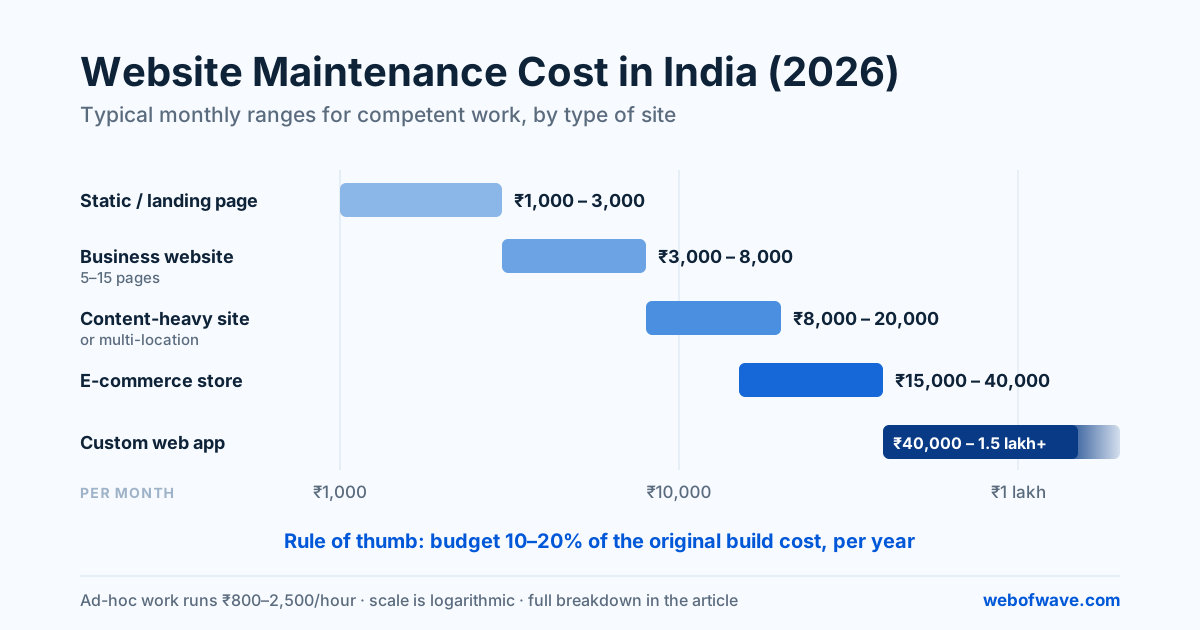
Ad-hoc work, when you don't have a plan, runs roughly ₹800–2,500 an hour depending on who's doing it. That's usually the more expensive route once you need more than an hour or two a month — and it's always the more expensive route in an emergency.
The 10–20% annual heuristic is a decent sanity check. If a ₹3 lakh store is being maintained for ₹1,500 a month, either you're getting a favour or nobody is actually looking at it.
What your stack does to the bill
Maintenance cost is decided at build time, and this is the part nobody mentions when you're choosing a platform.
WordPress / WooCommerce. Cheapest to build, most expensive to maintain. Core, theme, and a dozen plugins each update on their own schedule, plugins conflict, and something eventually breaks after an update that worked fine on staging. The maintenance burden is real work, not paranoia.
Shopify. The platform maintains itself, which genuinely removes a category of risk. What you pay instead is the plan fee plus app subscriptions, every month, forever — and app updates or deprecations still occasionally break things you built around them.
Custom Next.js or similar. Low routine maintenance — no plugin ecosystem to babysit — but dependency upgrades come in less frequent, larger chunks, and you need someone who knows the codebase. Cheap to keep running, more expensive to change if you lose access to the original team. We compared the trade-offs in detail in Next.js versus WordPress for business websites.
None of these is the "right" answer. But if minimising ongoing cost matters more than build cost, that should influence the platform decision on day one, not after the first renewal.
The cheapest website to build is rarely the cheapest website to own. Ask what maintenance will cost before you sign the build quote, not twelve months later.
The fine print worth reading
Four clauses that decide whether a plan is worth what you pay.
"Unlimited changes." Nobody offers unlimited engineering. In practice it means unlimited small text and image edits, and anything structural is quoted separately. That's a fair deal — just get the boundary defined, ideally with examples on both sides of the line.
Response time versus resolution time. "We respond within 24 hours" is not "your checkout will be working within 24 hours". For anything that takes payments, ask specifically what happens when the site is down at 9pm on a Saturday, and whether that's covered or billed.
Who holds the keys. You should own your domain registrar account, DNS, hosting account, and code repository — with your agency added as a user, not the other way round. This is the single most common trap we see: businesses that can't move their site because a former developer owns the accounts. Ownership is not a trust issue; it's basic continuity.
Rollover and reporting. Do unused hours carry over? Do you get a monthly note of what was actually done? A plan with no reporting is impossible to evaluate at renewal, which is generally the point.
Do you actually need a plan?
Honestly, not everyone does.
Probably skip it if you have a small static site, no logins or payments, a stack that doesn't rot, and you're comfortable editing your own content. Keep backups and monitoring running, keep the domain on auto-renew, and buy help by the hour when you need it.
Get a plan if your site takes payments, stores customer data, runs on WordPress with plugins, is your primary source of leads, or costs you real money for every hour it's down. In those cases, maintenance isn't overhead — it's the cheapest insurance available.
The middle case: a plan at the smallest tier that still covers backups, monitoring, and security. Change hours are the part you can trim; risk cover is the part you shouldn't.
Questions to ask before signing
- What exactly is included, and what's billed separately? (In writing.)
- How often are backups taken, where are they stored, and when was a restore last tested?
- What's the response time, and what's the process for a site-down emergency?
- Do I own the domain, DNS, hosting, and code repository?
- Will I get a monthly summary of work done?
- Do unused hours roll over?
- What happens if we part ways — how is everything handed over?
That last one tells you the most. An agency confident in its work answers it without hesitating.
If you're weighing what a site will cost to own rather than just to build, our breakdown of e-commerce website costs in India covers the build side of the same maths — and if you'd like a maintenance scope written against your actual stack and risk rather than a generic tier, that's part of how we hand over every website development project.
Want help putting this into practice? See our Website Development service or get a free audit.