Local SEO in India comes down to three things: a fully completed Google Business Profile with the correct primary category, consistent business details everywhere you appear online, and a steady flow of recent reviews. Website work matters, but it amplifies those signals rather than substituting for them.
Most businesses we talk to have already "done SEO" — someone built the site, added some keywords, maybe wrote blog posts. And they still don't appear when a customer three kilometres away searches for exactly what they sell. That's because local search runs on a partly different set of rules, and the highest-leverage work happens outside your website.
Local search is two results, not one
Before fixing anything, understand what you're competing for. A search like "dentist in Indiranagar" returns two distinct blocks, ranked by different systems:
- The map pack — the three business listings with a map, stars, and phone numbers. Ranked mostly on your Google Business Profile, proximity to the searcher, and review signals.
- The organic results below it — normal blue links. Ranked on classic SEO: content, links, technical health, site speed.
They're scored separately. You can hold the top organic result and still be invisible in the map pack, which is where most phone calls come from. So the first question isn't "how's my SEO?" — it's "which of these two am I losing, and why?"
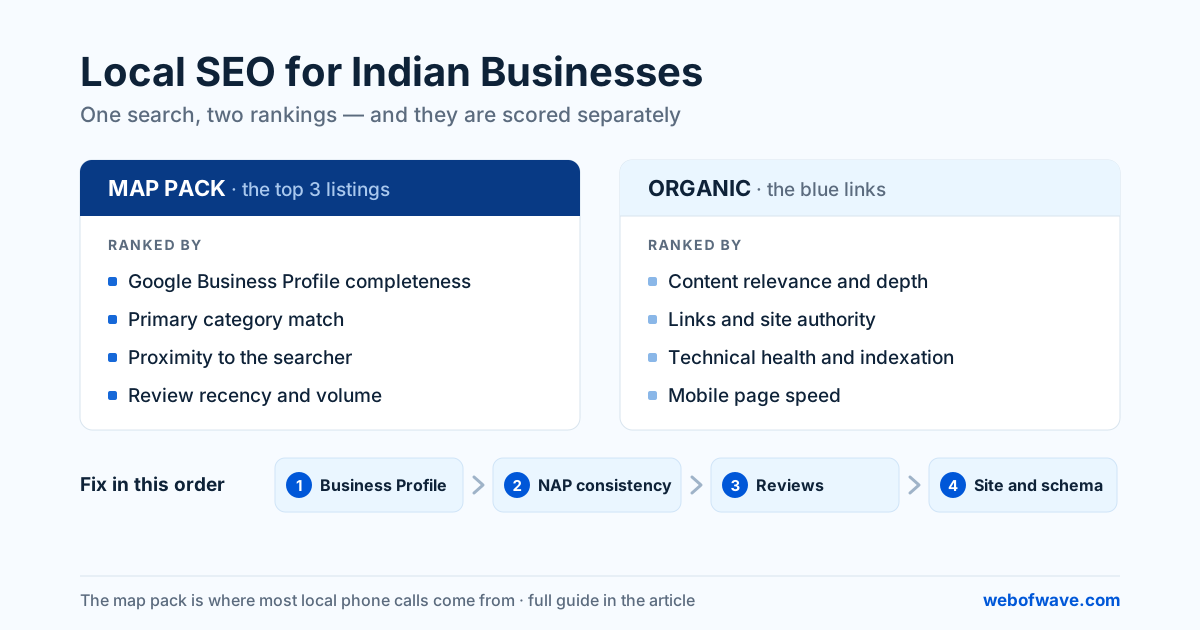
For most Indian SMBs — clinics, salons, law firms, gyms, coaching centres, local retail — the map pack is where the money is, and it's usually the cheaper one to win.
Google Business Profile: the single highest-leverage asset
Your Business Profile is a free listing that outranks your own website for most local queries. Treat it as a product, not a form you filled in once.
What actually moves the needle:
- Primary category. The most underrated setting in local SEO. "Dental clinic" and "Dentist" are different categories with different competitors. Pick the one that matches your highest-value service, then add secondary categories for the rest.
- Complete every field. Hours (including holiday hours), services, attributes, description, service areas, booking link. Google favours complete profiles, and completeness is the one competitive advantage that costs you nothing but an afternoon.
- Real photos, added regularly. Interior, exterior, team, work. Profiles with recent photos are visibly more clickable, and click-through feeds back into ranking.
- Products and services listed individually, each with a description. This is free keyword surface area most businesses leave blank.
- Q&A. You can ask and answer your own questions. Seed the five your front desk answers daily — parking, fees, walk-ins, languages spoken, insurance.
- Posts. Weekly updates, offers, or events. Low effort, and they keep the profile visibly active.
One warning: keyword-stuffing your business name ("Sharma Dental — Best Dentist in Pune") is a violation, competitors will report it, and suspensions take weeks to appeal. Use your real name.
NAP consistency: boring, and it decides everything
NAP is Name, Address, Phone. Google cross-references yours across the web to decide whether you're a real, stable business.
The problem in India is that your details are usually scattered across Justdial, IndiaMART, Sulekha, Practo or Zomato, an old Facebook page, two directory listings someone built in 2019, and your own footer — and no two of them match. Different phone number, an old shop number, "Rd." versus "Road", a landline that was disconnected.
Fix it in this order:
- Decide the canonical version of your name, address, and phone — exactly as it should appear everywhere, down to punctuation.
- Put it on your website footer and contact page first, as plain crawlable text, not inside an image.
- Update Google Business Profile to match exactly.
- Then work through the directories, starting with the ones that actually rank for your keywords.
Local SEO is less about clever optimisation than about removing contradictions. Google ranks the businesses it is confident are real, open, and exactly where they say they are.
Reviews: recency beats volume
Reviews influence both ranking and whether anyone calls you after seeing the ranking. Two practical points most guides skip:
Recency matters more than the total. A business with 40 reviews including six from the last two months usually outperforms one with 200 reviews that stopped in 2024. A dead review profile reads as a dead business.
Owner responses count. Reply to every review, including the bad ones — briefly, factually, without arguing. Prospective customers read the responses more closely than the complaints.
Build a system rather than a campaign: a short link (Google gives you one from your profile) sent by WhatsApp after service, asked for by the person who actually did the work, at the moment the customer is happiest. Never offer discounts for reviews, and never buy them — filtered reviews and profile penalties are not worth the shortcut.
Location pages, and the doorway-page trap
If you serve multiple areas, resist the instinct to spin up twenty pages that differ only in the city name. Google calls these doorway pages, and they're explicitly against guidelines.
A location page earns its place when it has genuinely local content:
- The actual address and embedded map for that branch
- Staff, timings, and phone number for that location
- Directions, landmarks, parking, nearest metro station
- Case studies, projects, or testimonials from that area
- Local pricing or services if they genuinely differ
If you can't fill that honestly, you don't need the page. One strong service page that ranks is worth more than ten thin ones that dilute each other.
The website side: schema, speed, and structure
Once the profile is in order, your site should back it up.
LocalBusiness schema. Add structured data with your name, address, phone, opening hours, geo coordinates, and price range. It doesn't magically rank you, but it makes your details machine-readable — which matters increasingly for AI answers, not just Google.
Embed a real map on the contact page, and make the phone number a tel: link. Half of local searches happen on a phone; a number the user has to copy is friction you're paying for in lost calls.
Speed and mobile. Local searchers are impatient and often on mobile data. If your contact page takes six seconds on 4G, the ranking you fought for leaks away at the last step — our Core Web Vitals guide covers what to measure and fix.
Fix the fundamentals underneath. Indexation, titles, internal links, duplicate pages. The technical SEO audit checklist is the version we run before starting any local campaign, because local work built on a broken site underperforms for reasons that look mysterious until you check.
Local intent in AI answers
A growing share of "who's good near me" questions now get answered by ChatGPT, Gemini, and AI Overviews — and those systems assemble answers from structured data, reviews, directory listings, and text they can parse confidently.
Practically, that changes little about what you do and a lot about how you write it. State facts plainly and in text: what you do, where you are, hours, service areas, prices where you can. Answer real questions in full sentences. Avoid burying essentials in images, sliders, or PDFs. The same clarity that helps a stranger skim your site helps a model quote it — we go deeper on this in the AI search optimisation guide.
What to do in the first 30 days
In rough priority order, because doing these in sequence beats doing them all badly at once:
- Claim and verify your Google Business Profile
- Set the correct primary category, add secondary ones
- Complete every field — hours, services, description, attributes
- Upload 10+ real photos
- Fix NAP on your site, then on Google, then on the top five directories
- Add LocalBusiness schema and a
tel:phone link - Ask your last 20 happy customers for a review, by WhatsApp, with the direct link
- Reply to every existing review
- Seed five Q&A entries on the profile
- Check how your contact page loads on a phone, on mobile data
Most businesses see movement from that list alone, before anyone writes a single blog post.
Local SEO rewards consistency more than cleverness — the businesses that win are usually the ones that kept the profile updated and the reviews coming while competitors did it once and stopped. If you'd rather have this handled properly and measured against calls rather than rankings, that's what our SEO and technical SEO work is built around.
Want help putting this into practice? See our SEO & Technical SEO service or get a free audit.