A professional business website in India costs roughly ₹15,000–60,000 for a few well-built pages, ₹40,000–1.5 lakh for an online store, and ₹2 lakh upwards once logins, dashboards or custom workflows are involved. The spread is wide because "website" describes wildly different projects — so the useful question is not what a website costs, but what moves the number.
We quote these builds every week. Here is the honest breakdown, including the costs that rarely appear in a quote and the cases where spending less is the right call.
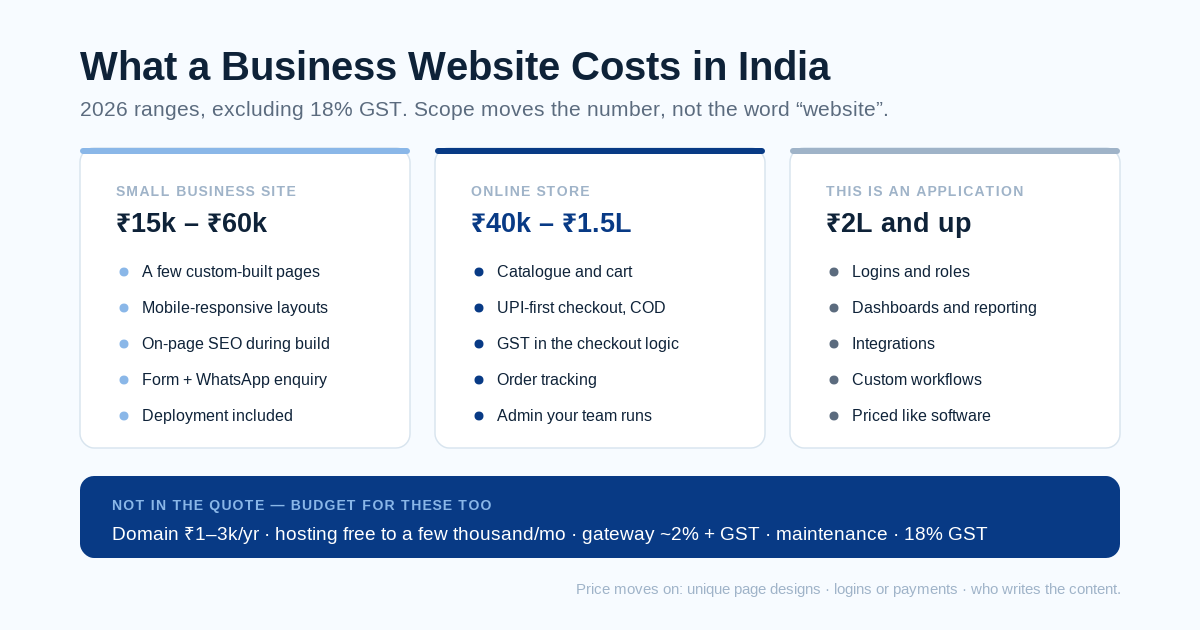
What each budget actually buys
Rather than vague tiers, here is what the money maps to in practice.
₹15,000–60,000: a professional small business site
A handful of pages, custom-built rather than assembled from a template, mobile-responsive, with on-page SEO done during the build and an enquiry path that works — usually a form plus a click-to-WhatsApp button. Deployment included.
At the lower end of this range you are getting fewer unique page designs, your own content, and a straightforward structure. At the upper end you get more pages, more considered design work, and room for things like a blog or a service-wise structure that can rank for several terms rather than one.
This is the right budget for most service businesses, consultants, clinics, institutions and local shops. It is also enough to get a genuinely fast site — speed is an engineering decision, not a price tier.
₹40,000–1.5 lakh: an online store
Everything above, plus a product catalogue, cart, checkout wired to a payment gateway, order management and an admin your team can actually operate. In India that also means UPI as the default payment method, cash-on-delivery handling where your margins allow it, and GST handled in the checkout logic rather than patched onto the invoice.
The range is wide because catalogue size and integrations vary enormously. Fifty products with one shipping rule is a different project from two thousand SKUs with variant pricing and a courier integration. We broke the store-specific numbers down further in e-commerce website cost in India.
₹2 lakh and up: an application
Once a website needs users to log in, it stops being a website in any useful sense. Roles and permissions, dashboards, reporting, integrations with systems you already run, data that has to stay consistent and auditable — that is software, and it is priced like software.
The giveaway is in the brief. If the requirements include the words "admin can", "manager approves" or "report exports", you are buying an application. Quoting that as a website is the most common reason a project runs late and over budget.
The three things that actually move the price
Strip away the sales talk and almost all variation comes down to these.
1. The number of unique page designs. Not pages — designs. Fifty product pages using one template is cheap; five pages that each need their own layout is not. When you ask for a quote, say how many genuinely different layouts you need.
2. Whether anything needs a logged-in user or a payment. This is the single biggest step change in cost. The moment a site has accounts or takes money, it needs security, error handling, edge-case handling and testing that a brochure site simply does not. There is no cheap version of doing that properly.
3. Who writes the content. Agencies price this very differently, and many quietly assume you will supply everything. Copy, product descriptions, photos and policy pages take real time. If you want someone else to write them, that is a line item — and if you are supplying them, your own timeline depends on it more than on the development.
Two quotes that differ by five times are usually quoting two different projects. Before comparing prices, make both sides describe the same scope in writing.
What the quote probably does not include
This is where budgets get blown, and it is rarely malice — these costs just sit outside the build.
- Domain — roughly ₹1,000–3,000 a year, renewed forever. Register it in your own name, never the agency's.
- Hosting — free or near-free on Vercel for a static site; a few hundred to a few thousand rupees a month for heavier setups. A static site genuinely can cost nothing to host, and that is not a trick.
- Payment gateway fees — around 2% plus GST per transaction if you sell online, charged by the gateway, not the developer.
- Maintenance — updates, fixes, security patches, the occasional broken integration. Most quotes leave this at zero and you pay it anyway, which is why we wrote up what maintenance actually costs.
- Content and photography — see above.
- GST — 18%, usually added on the invoice. A ₹40,000 quote is ₹47,200 payable.
None of these are large individually. Together they are the difference between a budget that holds and one that does not.
When spending less is the right call
We turn down work on this basis regularly, so it is worth saying plainly.
If you are still testing whether anyone wants what you sell, do not commission a ₹60,000 site. One honest page — what you do, who it is for, a price, and a WhatsApp button — tells you what you need to know for a fraction of that. You can grow it later; the domain and the content carry over.
If your customers are already finding and paying you through Instagram and WhatsApp and nobody is asking for a website, you may genuinely not need one yet. We went through the signs that it has become overdue in do you need a website if you have Instagram.
And if your budget is genuinely tight, a good freelancer will serve you better than a cheap agency. That is not false modesty — it is arithmetic, and we laid out the trade-offs in freelancer vs agency.
How to compare two quotes properly
Price alone tells you almost nothing. Four questions tell you a lot:
- What exactly is delivered, in writing? Page count, unique designs, who writes content, what happens after launch. If a quote is one number and a sentence, you cannot compare it to anything.
- Who owns the domain, hosting and code? The answer should be you, in your name, from the start. An agency holding your infrastructure is a cost you will pay later to escape.
- What happens after launch, and for how long? "We'll support you" is not an answer. Ask for a period, a scope and a response time.
- Did they ask about your customers before quoting? Anyone who gives you a number before understanding who buys from you is guessing. The ones who ask awkward questions first usually cost less overall.
Our own figures are public on the pricing page, including what is excluded — partly because we would rather you see the number before spending time on a call, and partly because an agency that will not publish a starting price is usually pricing against your perceived budget rather than the work.
The short version
For most Indian businesses reading this: budget ₹15,000–60,000 for a proper small business site, expect another ₹3,000–5,000 a year in running costs, and add 18% GST to whatever you are quoted. Spend less if you are still testing an idea. Spend more only when logins, payments or real integrations are genuinely in scope — and make sure the quote says so in writing before anyone starts building.
Want help putting this into practice? See our Website Development service or get a free audit.