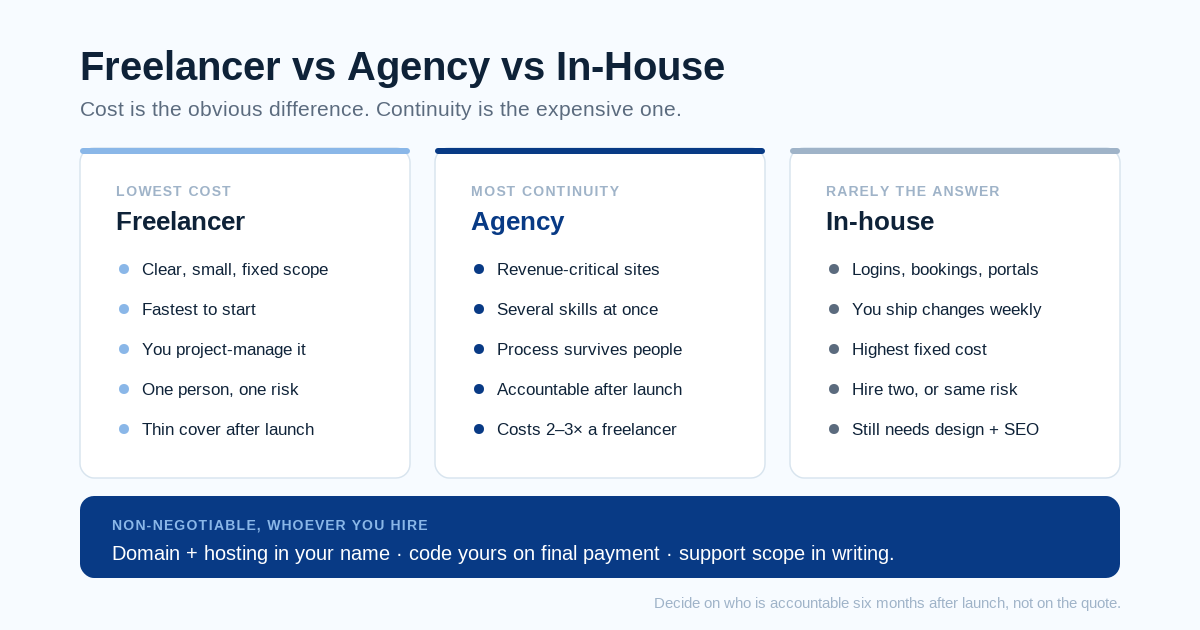
Hire a freelancer when the scope is clear and small, an agency when the website is tied to revenue and has to keep working after launch, and in-house only when the site is a product you change every week. Cost is the obvious difference; continuity is the expensive one.
Both of us in this comparison have an obvious bias — we're an agency. So this is written the way we'd explain it to a friend, including the cases where paying us is the wrong call.
Hire a freelancer when the scope is genuinely clear
A good freelancer is the best value in this market, and the cheapest route to a well-built small site. You're paying one person's time with no overhead, no account manager, and no margin stacked on top. For a brochure site, a landing page, a portfolio, or a well-specified WordPress build, that's usually the right trade.
Freelancers work best when:
- The scope is written down and small. Five pages, known content, no logins, no payments.
- You can brief and decide quickly. One freelancer with one decisive client is the fastest arrangement that exists.
- You know what you want it to look like. Give them references and they'll execute. Ask them to invent a brand and a strategy and you're outside what most are set up for.
- Your budget genuinely can't stretch. A competent freelancer beats a cheap agency every time.
The real risks aren't about skill. They're structural:
One person is one point of failure. Illness, a full-time job offer, a family emergency, or a better-paying client — any of these can stall your project, and there's no bench to cover it. Mid-project disappearance is the single most common story we hear from businesses that come to us for a rescue.
Breadth is uneven. A website needs design, frontend, backend, content, performance work, and technical SEO. Most freelancers are genuinely strong in two or three of those. The usual casualties are the invisible ones — performance and SEO — which is why a site can look lovely and still never appear on Google. Our technical SEO checklist covers what typically gets skipped.
After launch, you're in a queue. Not neglect — just arithmetic. A freelancer juggling four clients will take a day or two to reply, and that's fine for a copy change and painful when checkout is broken on a Saturday.
Price fluctuates with availability. Rates vary enormously between an experienced developer and someone taking their first paid project. Treat an unusually low quote as information.
Hire an agency when the site has to keep working
What you're actually buying from an agency isn't superior code. Plenty of freelancers write better code than plenty of agencies. You're buying continuity and accountability — a team where more than one person knows your site, a process that survives any single person leaving, and a company that's still reachable in eighteen months.
That matters when:
- The website is tied to revenue. E-commerce, bookings, lead generation — anything where a day of downtime is a measurable loss rather than an annoyance.
- The scope will change while you build. Most real projects discover requirements halfway through. Teams absorb that better than individuals.
- You need several skills at once. A properly built store needs design, payments, tax logic, performance, and search visibility working together, which is most of why e-commerce costs what it does.
- You don't want to project-manage it. With a freelancer, you are the project manager — chasing content, reviewing stages, keeping the schedule. That's unpaid work, and if you're the business owner it's your most expensive hour.
- Someone has to be accountable after launch. Updates, security patches, broken integrations, a plugin that breaks on a Tuesday. This is the part people price at zero and then pay for anyway, which we broke down in website maintenance cost in India.
The honest downsides: you pay more, often two to three times a freelancer's quote for a comparable brochure site. You get more process, which is slower at the start. And "agency" covers everything from four specialists to a reseller who quietly subcontracts your project to a freelancer anyway — at a markup. Ask directly who writes the code.
Don't compare the quotes. Compare who is accountable six months after launch, because that's where the real cost of this decision shows up.
Hire in-house only when the website is a product
A full-time developer makes sense far less often than founders expect, and the test is simple: how often does the site change?
If the answer is a few times a year, a salary is the wrong instrument. You'd be paying permanently for capability you use for a few weeks, and you'd still need design and SEO help from outside.
In-house starts to pay when:
- Your site is really an application — logins, dashboards, bookings, internal tools, a customer portal. That's the territory of custom web apps, not brochure sites.
- You ship changes weekly and waiting on an external schedule actively costs you money.
- The domain knowledge is deep enough that re-briefing an outsider each time is slower than employing someone.
- You can hire two, eventually. One developer who knows everything and takes leave is a risk, not a solution.
A pattern that works well for growing Indian businesses: an agency builds and hardens the first version, then an in-house developer maintains and extends it once there's enough change to justify the seat.
The five questions that decide it, whoever you hire
These matter more than the freelancer-versus-agency question, and they're where we see the real money lost.
- Who owns the domain and hosting? Register them in your own or your company's name, with your own email, and keep the login. Vendors "handling it for convenience" is how businesses end up hostage to a renewal they can't pay directly. Non-negotiable.
- Who owns the code and the designs? You, on final payment, in writing. Also ask what it's built on: a standard stack someone else can pick up, or something only they can maintain?
- What exactly happens after launch? For how long, covering what, with what response time, at what cost. "We'll support you" is not an answer. Vague here means absent later.
- Can I see three live sites you built that are still running? Load them on mobile data yourself. Fast, working, still online a year later tells you more than any portfolio page.
- Did they ask about my customers before quoting? The ones who quote a number before understanding who buys from you are quoting on a guess. The ones who ask awkward questions first usually cost less overall, and are more likely to give you a realistic timeline instead of an optimistic one.
A rule of thumb to finish with
- Budget under ~₹50,000, clear and small scope: a good freelancer, with ownership and support terms written into the email thread.
- Revenue-critical, e-commerce, or scope still forming: an agency, chosen on its live work and its answer to question 3.
- Site changes weekly and is effectively a product: in-house, ideally after someone else has built and stabilised version one.
- Anyone quoting far below the rest: find out why before you decide. Sometimes it's a developer early in their career doing honest work at an honest price, which can be a bargain. Sometimes it's a template with your logo dropped on it.
Rebuilds are the expensive outcome, and they're almost always caused by the same thing: nobody agreed who was responsible after launch. Decide that part first and the rest of this choice gets much easier. If you'd like us to look at a quote you've received and tell you whether it's reasonable, we'll do that on a website development enquiry without pitching you.
Want help putting this into practice? See our Website Development service or get a free audit.